Eastern Church History
Lecture Notes
By Steve Puluka
Text book available from:
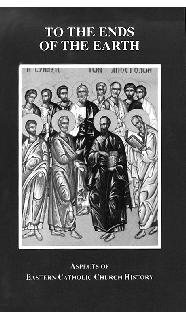
The Twelve go forth from Jerusalem
The Preaching of the Apostles
The Apostles reached out to the Jewish community
first. When they went to new cities, they appeared in the synagogue
and preached how Jesus was the Messiah. Since they were a minority
sect, they kept together as a community against the rest of the
world.
The core teaching of our faith is found in the sermons
preserved in Acts of the Apostles and the early letter from Paul.
These communities took what was taught by the Apostles and remained
faithful to it. There is NO INNOVATION in theology. Jesus
Christ is the same yesterday, today and forever.
Opening to the Gentiles
Jewish society was religiously based. You could not
be a part of the Jewish culture without joining the faith of Abraham.
Further, you could not join the faith of Abraham without full
membership unless you accepted all
the faith practices, the most difficult for those interested being
circumcision.
There were many sects of Jews who all came to the
Temple to sacrifice together. They each held classes of a sort
in the courtyard of the temple in Jerusalem and at the local synagogues
around the world. There was a tremendous diversity in Jewish thought
at this time, much the way we see a large number of Christian
denominations today.
If you were interested in the faith of the Jews,
you could come to the temple to listen to the rabbis teach. Many
people in that secular age were attracted to the deep spirituality
of the Jews. They came to the temple to learn more. Those who
accepted much of the faith, but who didn't bring their household
into the faith by circumcision, were known as the ñGod-fearersî.
As the Christian Jews participated in the daily dialogue
at the local synagogue, these Gentiles also heard the message
of Jesus. When the Christians were proclaimed a heretical sect
by the mainstream Jews and were forced to leave the temple, the
Gentiles came with them. The Christian church then decided that
one did NOT have to be a Jew to become a Christian. This was the
subject of the first council of Jerusalem, whose story is told
in Act chapter 15. This is also the reason for Paul's rebuke of
Peter in Galatians chapter 2.
Characteristics of the New Testament Church
The community of Christians was characterized by
love. This was expressed by a community that cared for its own,
held all possessions in common, and whose chief meeting was a
communal meal. These churches were held in the homes of one of
the wealthier members who supported the local community this way.
Each local community was a witness to Christ.
Connection with the Apostles
What held all the local churches together was the
common tie of the Apostles. Each community could tie its very
existence to one of the Apostles. From the earliest times this
was the test of truth.
Today only the Catholic and Orthodox churches continue
to hold this principle as one of the central tenets of the faith.
Fullness of the Local Church
In the Jewish faith of the time, the Temple in Jerusalem
was the fullness of IsraelÍs connection with God. Only
in Jerusalem could sacrifice to God occur. The Christian relationship
to God changed this mode of thinking. Each local ñhouse
churchî contained the fullness of the church. The community
meeting together for the ñbreaking of the breadî
is the full expression of the church.
The community is not a part of the church but IS
the WHOLE church present for the faithful.
A Communion of Local Churches
At the same time, the communion of the local community
extends to include other local churches. On a practical level
the larger communities in the bigger towns established and served
the small villages. There was a clear dependence of the smaller
villages on the larger towns.
The larger towns were established first and even
small towns had a local leader (bishop). As the community grew
the bishops ordained presbyters (priests) to run the churches
in a local area. These priests would travel to the small groups
in the outlying villages and serve them. When the community in
that village became large enough and strong enough in the faith,
one of their own would be ordained to serve them.
Provinces and Patriarchates
While even very small trading towns would have a
bishop that cared for the surrounding area, the major metropolitan
areas became responsible for the smaller towns around them. They
would send help in need and assist in local disputes.
After Christianity was legalized they officially
adopted this organizational structure at the first council of
Nicea. Metropolitans were established over other local bishops.
This structure was borrowed entirely from civil government
of the empire. The next level of organization was the major regions
of the Empire which became the Patriarchates of the Church. These
were Constantinople, Rome, Antioch, Alexandria and Jerusalem.
Jerusalem was NOT a major administrative center of the empire
but was a Patriachate because our salvation occurred there.
Communion Expressed in Councils
The area where the Church diverged from civil practice
was in the decisions of the Councils. There is no civil parallel,
past or present, for this activity in the church. While the Christian
Church of the Empire was large enough to need a good organizational
structure, the Church was still NOT a government, special interest
group, club, or association, but a COMMUNITY OF FAITH.
This community of faith is in union with Jesus through
the presence of the Holy Spirit. From the very beginning, with
the replacement of Judas among the twelve Apostles, the church
has trusted in the leadership of God, not people.
This leadership with the inspiration of the Holy
Spirit took the form of Councils of the leaders of the faith.
Acts details the first one held in Jerusalem, which defined the
relationship of the Christian faith to the Jews. The Gentiles
did not need to become Jews before they became Christians.
But the decision of a group of leaders is not unique
to the Church. First, this decision is debated in faith and in
prayer for guidance. This decision is announced to the faithful
everywhere for their contemplation. When the spirit moves the
whole community to accept these decisions they have effect, and
not before.
Councils were held throughout the regions and history
of the Church but many of them were rejected. The act of leaders
getting together to debate and decide something is NOT sufficient.
The decisions need to be affirmed by the community of the faithful.
The Councils that are affirmed by ALL the communities became known
as Ecumenical councils.
More councils were rejected than accepted. More councils
were of local issues and interest than were Ecumenical councils.
Return to History Class Home
Becoming a Mainstream Religion
Cultures in the Mediterranean World
Religion is as much an expression of culture as of
faith. We describe God in our prayers as ineffable and beyond
human understanding. This means that any attempt to understand
God must be by way of analogy from our human experience. Culture
is that human experience.
God choose the Semitic culture of the Jews as the
point of contact with the human race. Jesus choose the Greek-influenced
Roman Empire as the time to appear and teach. The Apostles choose
to pull additional insights from the cultures of the regions they
visited to bring people to Jesus.
Semitic culture is largely agricultural and nomadic
shepherds in nature. Their world dominance by the time of Christ
was a thing of the past. Religiously, the Jews insisted there
was only one God and refused to make images of God. This stood
in stark contrast to the rest of the world, which loved ornate
religious imagery.
When Alexander the Great conquered most of the known
world he brought Greek culture with him. Logic, philosophy, art,
literature and games from Greece appeared throughout the region.
Many leaders of the Jews lamented and fought this foreign intrusion
to their cultural life. Despite this dislike of foreigners, Greek
language and culture came to dominate the region.
The Roman empire expansion into Israel was actually
at the invitation of the Jewish leaders to help combat the Greeks.
Once in, they presented problems of their own. Rome conquered
areas and used local people to rule the conquered nations. The
Jews became just one more province of the empire.
Egypt shared a common liturgical tradition but two
languages, Greek in some of the major cities and Coptic in the
rural areas. Great care was taken to assure that the faithful
understood what occurred in the Church. When the Bishop spoke
in Greek a translator stood by to render this for the Coptic faithful
present.
Another cultural area was east of the holy land in
Mesopotamia. The Christian community here was largely established
by the Jewish Christian flight from Jerusalem after the destruction
of the Temple in 70 CE. These people of Jewish descent wanted
to leave the area of Roman persecution to the outer fringes of
the empire. They are recognized as the ancestors of the Maronite
Churches today.
In summary, when the Christians moved throughout
the empire they preached in the language the people could understand,
usually Greek, and adapted customs from the local people for explaining
Christian beliefs.
Development of the Byzantine Church
When Constantine the Great legalized the Christian
faith in 313 AD, the makeup of the Christian Church began to change.
Much of what the Church taught and how it was organized was firmly
established by this time, but the cosmopolitan nature of the Byzantine
capitol and the new needs of an official religion caused some
profound developments.
With the persecution of the church over, greater
communication between the various communities was possible. Further,
the need to bring into the faith large new groups of people demanded
more definition from the leaders on what Christianity meant. The
Byzantine empireÍs capitol was famous as a melting pot
of its time, very much like the United States is today.
These factors led to the great Byzantine Synthesis
of Tradition, Liturgy and Theology. For more than a thousand years,
through many heresies and cultural advances, the capital of Constantinople
became the leader of Eastern Christianity. Here the mystical theology
of the Eastern Churches was articulated fully in this period,
while the West pursued the scholastic emphasis leading to Roman
Catholic Systematic Theology.
One important difference between the approach of
east and west was the use of liturgy for theology. The period
of Byzantine synthesis was characterized by hymnography and liturgical
songs expressing these theological truths. While the West pursued
the deeper understanding of the human mind in scholarship for
a few, the East placed our deepest truths into song for all the
faithful to sing and understand, each according to their own ability.
The Syriac Tradition
Antioch remained an important area for the development
of the Eastern Church, even after Constantinople took the clear
leadership role. AntiochÍs approach was more biblically-based
than Constantinople's, and Antioch became one of the centers of
monasticism.
Since monasticism was a lay movement and by its very
nature a rural one, the monasteries tended to be Syriac-speaking
around Antioch, or Coptic in Egypt. The further removed the monasteries
from Greek cities, the less concerned they were with Greek philosophical
theology. The monks produced hymns and metered homilies in the
Syriac tongue.
Missionary Expansion of the Church
After this early period the fundamental concepts
and approaches to God became fixed, while the experience of the
church for the people remained changeable during missionary expansion.
Geography was the deciding factor in this expansion.
Antioch
became the first missionary center by sponsoring
Paul and his companions throughout the Mediterranean. They also
expanded east to Persia, north to Soviet Georgia, and south to
Caucasus.
Alexandria
sponsored missions to Yemen, Nubia and Ethiopia.
The Yemeni church was destroyed by Islamic conquest. The Ethiopian
Church constitutes the first synthesis of African spirituality
with Christian beliefs. This church, centered in the capital of
Axum, also claims to hold the great Jewish relic of the Ark of
the Covenant. A single monk stands vigil over the relic for his
entire life in a monastery out of public view. All Ethiopian sanctuaries
use a replica of this relic as the center of the sanctuary. On
major feasts the ark is brought in procession through the town.
Constantinople
sent missionaries east and north throughout the Baltic
states. Cyril and Methodius are the most famous missionaries to
these lands. Each area created its own national church using the
Greek liturgy as a basis, but translating all the services and
scriptures to their own tongue. Cyril is credited with adapting
the Greek alphabet to the Slavic sounds that we know today as
Cyrillic. Many of the westernmost areas of eastern Europe became
places of conflict for Rome and Constantinople. As both had missionaries
working in the area, the Pope had to intervene to keep the peace
on several occasions. This includes a famous trip to Rome by Cyril
to have their work in translating scripture and liturgy to the
vernacular approved and blessed by the pope.
Rome
established missions throughout western Europe and
beyond through the host countries colonial efforts in later years.
The biggest difference between the Roman missions and those of
the east was the complete lack of adaptation to the language or
ritual for missionary countries.
Return to History Class Home

They Were Torn Asunder
Most human organizations are fraught with division
and disagreement. Any organization of substantial size experiences
this tendency in human nature and must deal with the outcome.
Acts of the Apostles details several people being expelled from
the community to preserve the original faith intact. As the years
progressed, clergy and bishops would lead entire populations of
the faithful into heresy.
Nicea and the Arians
Arius was a poplar priest from Alexandria who objected
to the teaching that Jesus was co-eternal and equal to the father.
The first Ecumenical council of Nicea condemned Arius and his
teachings and the heresy died out two generations after his death.
Ephesus and the Nestorians
Nestorius was the Patriarch of Constantinople. He
held that Jesus' two natures, divine and human, were completely
separate, and did not allow Mary the title of God-Bearer. The
council of Ephesus affirmed this title for Mary and renounced
the theology of Nestorius.
Nestorius and the theology schools that supported
this view were exiled to the east. Here they lost contact with
the Ecumenical Patriarchates. They became an eastward-looking
community with missions throughout the far east.
Today they have small communities in Kurdestan, Iran,
Iraq, India, North America, Europe and Australia.
Chalcedon and the Monophysites
Since the controversy of the nature of Christ continued
even after Ephesus, the Council of Chalcedon attempted to clarify
the issue. Here the Fathers decided that Christ was one person
with two distinct and unconfused natures united.
This decision split the church on ethnic lines. Greek
accepted, while Coptic and Syriac rejected the decision. As a
result there were two rivals claiming to be the rightful heir
to the Patriarchates of Antioch and Alexandria. Daughter churches
established from these cities likewise chose sides.
Those rejecting the council of Chalcedon were called
Monophysites while those who accepted became known as Melkites.
While recent discussions have resolved the theological
differences of these groups many other obstacles remain before
full communion can be restored.
The Maronites
The monasteries of the Syriac-speaking church strongly
opposed the council of Chalcedon, with the notable exception of
Beit Maron. This became the center for all monks supporting the
council and the origin of the Maronite Church.
Rome and Constantinople
The schism between Rome and Constantinople is traditionally
fixed to 1054 and resulted from the Roman insertion of "and
the Son" (Filioque) into the Nicene creed. This is the year
that the Patriarch of Constantinople and the Papal legate exchanged
excommunication over the issue.
Long before this there were serious tensions between
the two capitals. The issue of which Patriachate held primacy
for the whole church and the nature of that primacy was probably
more critical to the split than the insertion into the creed.
Rome maintained that its authority was one of position
established by the Apostles, while Constantinople insisted it
was one of secular origin due to the Roman empireÍs capitol.
If that was the case, the fall of Rome as capitol and important
city meant that Rome should have fallen from primacy of honor
also. Constantinople referred to the city as the "New Rome".
This general view would come back to haunt Constantinople
after the Ottoman Turks sacked the city and they lost their political
and civil power. The relatively new Patriarch of Moscow claimed
title as the third Rome and the primacy of honor.
Other tensions between the capitol existed over control
of mission areas in eastern Europe. Bulgaria was claimed by both
Rome and Constantinople.
The mutual excommunication was removed in 1965 by
resolving the issue of the creed, but the issue of primacy and
jurisdiction still prevent union today.
Roman Catholic Fragmentation: The Protestants
The late middle ages exposed the Western church to
a new variety of schism. All of the above mentioned breaks occurred
over specific theological differences among parties who claimed
to be the true holders of the faith of the apostles. Each group
had much more in common than it had differences.
Abuse of political power and corruption of the Roman
Church at the highest levels prompted an unprecedented departure
from the church structure established in the first centuries.
Protestant reformers believed that the papacy was wrong. This
led them to reject not only the authority of that Pope (Patriarch
of Rome), as had been done at Chalcedon, but also to deny that
ANYONE should have such authority.
This attack on the authority of the church ultimately
led to many denominations with varying adherence to traditional
services, mysteries, and traditions of the church. The Protestants
were united in their rejection of the Pope and acceptance of scripture,
but held little else in common among the various denominations.
These divisions were often driven by early kingsÍ
political goals in obtaining land controlled by the Pope or other
conveniences of state.
Divisions within Orthodoxy: The Traditionalists
Shortly after the Reformation, liturgical reforms
in Russia prompted the "Old Believersî schism. This
substantial group opposed the reforms, which had brought the Russians
up to contemporary Orthodox practice. This was as much a protest
against the Westernization policies of Peter the Great as the
liturgical reforms in the Church.
In recent times, Orthodox attempts to use the Gregorian
calendar have prompted groups to protest and break off communion
with bishops. Ecumenical dialogue by Orthodox leaders, including
the Patriarch of Constantinople, has prompted condemnations, excommunication
and anathema from various Orthodox communities, especially monastic
ones.
Change is the biggest challenge for an Eastern Church.
We are called to preserve our faith unchanged while at the same
time interpreting the faith to the culture of the faithful. Where
to draw the line on what should not be discussed or changed and
what needs to be interpreted is very difficult. But this is the
vocation of the bishop and priest.
Return to History Class Home

May They All be One
Forced Union
The great schism of 1054 between Rome and Constantinople
allowed the Fourth Crusade to justify the occupation of Constantinople.
The leaders of this crusade sacked the city for all valuables
and presented the seat of the Patriarch as a trophy to the Pope.
Rome established a Latin Bishop as Patriarch and declared the
schism mended in 1204.
Rome viewed the union as a simple extension of the
Latin church. Eastern ritual and theology was abolished and replaced
with the practices of Rome. This union only lasted until the crusaders
were driven from the city in 1261.
Lyons Council
In 1274 the Council of Lyons was convened to discuss
reunion. Constantinople was under the threat of attack from another
crusade and wanted to avoid an occupation by the meeting. While
given the name ñcouncilî, it was really a meeting
with a demand that the Byzantine emperor's representative sign
the documents of reunion without discussion.
The religious representatives objected to a council
without discussion and to the content of the articles of faith.
While the Patriarch was promised a statement acknowledging the
primacy of Rome and commemorating this in the liturgy, the document
actually demanded Orthodox acceptance of the Filioque, the doctrine
of purgatory, and Rome as the source of ALL power.
The emperor's representatives signed the document
to avoid war but the church rejected the agreement.
Florence Council
The Ottoman Turks finally conquered Constantinople
in the 15th century. When the emperor saw this coming
in 1438, he attempted union with Rome in order to obtain military
assistance. Rome was experiencing its own problems with a rival
Pope and agreed to a real council discussion of the issues separating
the two powers.
The final documents affirmed that both leavened or
unleavened bread could be used for the Eucharist traditions, the
Filioque was a lawful expression, the Pope held primacy, and acknowledged
the existence of purgatory.
While this document was signed by most of the delegates
present, the Orthodox churches ultimately rejected this union.
Eastern Catholic Unions
While neither the councils of Lyons nor Florence
led to a lasting merger, Rome saw this as a method to achieve
union. Even if the whole of Orthodoxy did not accept these councils,
perhaps individual churches would.
Rome sent missions with theology books and other
scholars to anyone who would accept the entourage. These groups
observed the climate and attempted to reach common ground where
possible. They were not above using rivalries between bishops,
princes, or others to approach churches for the purpose of union.
Once an understanding could be reached, they would form a Uniate
Church.
Franciscans successfully brought one of two rival
bishops in Kurdestan into union with Rome. This Chaldean Catholic
church has a rocky history of union with both rivals coming into
and out of union with Rome at various points. The current union
was established in 1826.
Alexandria and Rome competed in Ethiopia creating
the G'eez (Coptic) Uniate church. This union was driven by the
princes of Ethiopia trying to escape Greek influence, and was
accomplished by the Jesuits.
The Ukrainian and Ruthenian Unions
Several factors led to the Ukrainian and Ruthenian
unions with Rome. For more than a century after the fall of Constantinople
to the Ottoman Turks, the poor rural regions of eastern Europe
were largely neglected by Constantinople. After visiting the region
in 1588, Patriarch Jeremiah II recognized the need for reform.
The area was poor and the clergy largely uneducated. He appointed
an exarch to oversee the local metropolitans and lay organizations.
These moves were resented by much of the clergy.
The region also resented the taxes it paid to Constantinople
to support the church. Being poor, and also taxed by the local
governments, caused the people to resent this extra burden their
neighbors did not have.
As the Protestant Reformation moved East, Orthodoxy
was forced to meet the theological arguments of the Protestants
just as the Catholics did before them. Many took refuge in the
western scholastic apologetics from Rome. As the violence of the
reformation wound down to the principle that people should follow
the religion of their rulers, Orthodox in these border lands found
themselves to be outcasts, belonging to neither the Catholic nor
Protestant groups.
These factors led the Ukrainians under Polish rule
to petition for union with Rome in 1596. The Union of Brest was
based on just two principles, equal status and the ability to
retain theology, ritual & discipline. Political upheaval in
Poland caused many of those in the union to return to the Patriarch
of Moscow when the territory was conquered by Russia, and return
to union when they were ejected.
In 1646, the Ruthenian jurisdictions sought to imitate
the Union of Brest for the same reasons. They obtained three promises
in the agreement, namely, retention of the rite, election of their
own bishops, and equal status.
Both of these unions exposed the Uniates to persecution
as traitors by the Orthodox, while at the same time they were
not accepted as equals by the Romans. Living in this middle ground
of being both united to Rome but also Orthodox in faith has proven
very difficult over the years.
The Romanians
When the Ottoman Turks were driven from Europe, the
Hungarian Empire took control of Romania. While religious freedom
was permitted for the Orthodox, union promised full equality with
the privileges enjoyed by the Roman Church, and was accepted at
the synod of Alba Julia in 1698.
In addition to the political rewards, Calvinism was
spreading rapidly in the area and the union offered the chance
to unite against this common enemy of the faith.
The Romanian Catholic Church suffered terribly in
recent times after World War II. When the Iron Curtain was erected,
everything with western ties was suppressed in many of the Balkan
countries. Romania was perhaps the most brutal in the suppression
of Uniate churches. After taking power, the Ceaucescu family arrested
all the Byzantine Catholic bishops in the country, had them shot,
and buried them in a place that remains secret today.
The Melkites
The Chalcedonian-following community of the Melkites
(chapter two) began the road to union in 1634. The middle east
was under Turkish control but they did allow some independence
for the Roman rite in their territories. This freedom was appealing
to some of the Melkite bishops.
Individual Patriarchs, bishops and communities professed
faith in union with Rome beginning in 1634. The union that exists
today dates from 1724. Shortly afterwards the Catholics were ejected
by the Turks at the request of the Orthodox, but returned in 1833.
To this day, the Melkites also lay claim to the Patriarchate of
Antioch.
The Syrian, Armenians, and Indians (Non-Chalcedonians)
The Syrians, the Non-Chalcedonian church of this
region, also split into a Catholic and an Orthodox branch. First
in 1662,but definitively in 1782, a Catholic Patriachate was established.
Similarly, the Armenian church split in 1712 but
the Catholics existed only as a church in exile in Italy. In 1740,
they established a Patriarchate in Lebanon for the Catholic branch
of this church.
The Church in India was re-discovered by the Portuguese
during their colonial period and brought into union with Rome.
This Church, which traces its conversion to the work of the Apostle
Thomas, began to be subjugated by the Portuguese. They appointed
their own people as bishops and changed the traditional practices.
This caused the church to split into rival Catholic and Orthodox
jurisdictions.
The Effects of Union
Uniate churches became the conduit for western education
and culture in their respective regions. As a result, Uniate clergy
were, on the whole, better educated than their Orthodox counterparts;
however, their education tended to be western influenced or, in
some cases, lacking in Eastern theology altogether.
The world began to rebel against central authority
in general throughout the west. The power of monarchs, including
the Pope, decreased as the people insisted on a more equitable
government. The Papacy responded to these threats, as did all
of the monarchs of Europe, by insisting on their legitimate authority
and strengthening their position wherever possible. The ultimate
expression of this position came during Vatican I in the 1870Ís,
in which the infallibility and ultimate authority of the Pope
was established over all other national churches.
Of the Uniate churches only the Melkites resisted
this trend, and ultimately not very forcefully. The Uniate churches
continued to suffer persecution from their former Orthodox brethren
while the authority of Rome removed most of their local control.
Rather than bringing the East and the West closer
together, Uniatism tended to increase the divide and sharpen the
differences. This is why the major barriers to union with the
Orthodox today are not theological in nature.
Repudiation of Uniatism
In the late 19th and early 20th century the Roman
Church began an introspective reflection on the faith. With the
example of their Protestant neighbors, many Roman Catholic clergy
and lay people began to see the flaws in the practices of their
church. Scholarship had replaced scripture, adoration of the Eucharist
had replaced reception, and rote memorization had replaced growing
in faith. Many began to question these traditional practices.
The Uniate Churches had adopted from the West many
of these rituals and practices. But we did not follow up in the
the questioning or the reforms.
These reforms in the Roman Church culminated in Vatican
II. Rome began to affirm the role of the Spirit and liturgical
life for spiritual growth. The balance of head and heart was restored.
At the same time, Rome realized that the Uniate churches needed
to be true to their own traditions. While still balancing the
head and the heart, with an emphasis on the head, they began to
see that the opposite balance was not only possible but necessary
for the equilibrium of the whole Church. Vatican II called on
the Uniate Churches to reform and return to the traditional approaches
of our forebears.
The fall of communism in the last decade brought
renewed vigor to the discussions of Union between Rome and the
Orthodox. The legalization of Uniate churches in the Orthodox
territories brought to the surface old rivalries and resentments.
The renewed freedom of expression for the Orthodox brought the
possibility of travel and dialogue with the West. In 1993, a meeting
of the Joint International Theological Commission agreed that
Uniatism was NOT the method to be used in the future for
union.
Return to History Class Home

East meets West in the New World
The nineteenth century brought Orthodox and Eastern
Catholic immigrants to the new world. Today, there are 29 Orthodox
jurisdictions and several Catholic and non-Chalcedonian ones as
well. This brought many Roman Catholics into contact with non-Roman
Catholics for the first time.
The first Eastern Catholics in America came from
the areas known to Rome as "Ruthenian". These immigrants
petitioned their homeland for a priest and were answered by Metropolitan
Sylvester in 1884, when Father Ivan Wolansky came to the coal
fields of Shenandoah, PA to serve the faithful. By the end of
the decade, more than 30 priests were in America.
Conflicts with American Catholics
Ignorance about the Eastern Catholic churches and
their union with Rome was widespread among the Roman bishops and
clergy. From the very beginning, Eastern Catholic priests had
difficulty obtaining the approval of local Roman bishops to practice
their faith. The first priest, Father Wolansky, was not only denied
the right to use Roman Catholic facilities, but also to enter
the churches. The Archbishop of Philadelphia refused to acknowledge
the existence of our church or the legitimacy of Father Wolansky,
who was married.
In response to complaints from Roman bishops, the
Vatican issued a decree in 1890 requiring all Eastern Rite Catholic
priests to get permission to practice from local Roman bishops.
This was based on the ancient principle of having only one bishop
per physical space. The decree also required that the priests
be celibate and the married ones already here be recalled. The
situation became worse as time went on. In the same year Father
Alexis Toth, a widower, led the Minneapolis parish to the Orthodox
over Archbishop Ireland's refusal to recognize him.
The situation improved slightly after Rome appointed
bishops to oversee the Eastern Catholics in America. But the stark
differences in practices bothered many Roman bishops. In the Roman
jurisdictions ethnic groups had their own parishes but they still
used the same rituals, customs and liturgy as the rest of the
Roman Church. Many Roman bishops could not understand why Eastern
churches weren't like that.
In 1929, the Vatican issued another decree at the
request of Roman bishops in America. Once again, they forbade
the ordination of married men or the immigration of married priests.
They also issued a multitude of other reforms for our churches.
This time the reforms remained, because of the obedience of the
Eastern Catholic bishops.
The decree also galvanized the forces against the
leadership of Rome. Eight married men who were only months away
from ordination were not ordained. Lay organizations like the
Greek Catholic Union fiercely protested the decree. Many parishes
left for the Orthodox and a brand new branch of the Orthodox church
was founded in Johnstown, PA under the protection of the Greek
Orthodox Patriachate of Constantinople.
The Problem of Assimilation
With the battle lines in many parishes sharply drawn
between the pro-Orthodox and pro-Catholic elements, assimilation
of Roman practices in Eastern churches increased. Churches in
union with Rome felt the need to be "different" from
the Orthodox and "similar" to the Catholics.
This wholesale abandonment of eastern traditions
(such as removal of icon screens and elimination of matins and
vespers) while adopting Roman traditions (Roman vestments altar
rails, First Communion, rosary, stations of the cross, Baltimore
catechism) led to an identity that was neither Roman nor Byzantine.
Even worse, the very spirit and essence of the church, and all
that made it a viable alternate path to God, was eroded.
The Challenges of the New World
Immigrants to the new world found comfort in keeping
alive the ties to the old country. The language at home, the rituals
and customs in church, and the ethnic celebrations all gave expression
to their identity in the community.
At the same time, being part of a new country and
culture was exciting. Much of this new life was far better than
the old one. The desire to be "American", meaning Anglo-Saxon,
would also lead to adopting Roman customs in the church.
The children of these people faced different concerns
but had many of the same results in church life. The United States
was the only home they knew. The "mother tongue" is
a second language, if it is spoken at all. The "new"
Latin practices of the church are all they ever knew. They often
pushed for even more "American" practices.
With the third generation and beyond we are seeing
a serious revival of traditional views in our church. The arrival
of this generation, along with Vatican II reforms, certainly helps.
More than ever we are beginning to see the true value of our faith
and practices, and are restoring them.
The Second Immigration
After World War II, the Ukrainian Byzantine Catholic
Church experienced a second major wave of immigration. The end
of the war brought a renewed vigor to the attacks on anything
with a western connection in the Soviet sphere of influence. Unfortunately,
the Byzantine Catholic Churches in Union with Rome were seen as
a threat to Moscow. This movement to make our churches illegal,
confiscate the property, and jail the clergy that would not return
to Orthodoxy, prompted large scale immigration from Ukraine.
Likewise, the Middle-Eastern churches experienced
a fresh wave of immigration around the establishment of Israel.
Economic distress and political unrest throughout this region
also brought increases in immigration.
These newcomers provided fresh challenges for the
established parishes of these groups. Recent arrivals like to
pray in their native tongue, while the second and third generation
Americans prefer the status quo. In the Ukrainian church calendar
reform was controversial with the recent immigrants, which lead
to new parishes being built very near to existing ones.
Over time, the culture of the church does adapt to
the new countries in which it spreads. The fact that we consider
the Greek, Romanian, Ukrainian and Russian churches to be different,
despite being established by the same missionary efforts, is witness
to this. As time goes on, we would expect the American churches
to evolve some of their own identities. The challenge is to be
sure that this is an authentic evolution and not a destruction
of the original .
Return to History Class Home

Be True to Yourself
The call from Rome has been issued for the church
to breathe with both Eastern and Western "lungs" again.
As an Eastern Church in union with Rome, we are called to witness
to the modern world our experience of Christ in the Eastern Church.
The Call to be Who We Are
It is incumbent on us to accomplish this witness
by learning and LIVING our spiritual heritage. Each union with
Rome brought periods of copying western models to "improve"
the eastern church. Now, more than ever we are asked by Rome to
return to our "roots". Liturgical and spiritual traditions
are not just a matter of gestures and words but the outward voice
of a spiritual reality.
Vatican II sums up this imperative: "If they
have improperly fallen away from them because of the circumstances
of time or personage, let them take pains to return to their ancestral
ways."
A recent follow-up to these instructions was issued
in 1996 by Rome. The rather succinct and dry Instructions for
Liturgical Reforms details a large number of Roman customs to
be eliminated, and Eastern ones to be restored. Central to this
document is a call to cooperate with our Orthodox brethren wherever
possible.
Further Aspects of the Tradition
The process of rediscovering our heritage must not
become a hunt for the perfect ritual. The liturgical life of the
church must reflect the inner spiritual life of the faithful.
We must take care to avoid the trap of the Pharisee and fall in
love with ritual for its own sake.
In looking back to our "roots", we find
other aspects of the church lacking. Many communities and bishops
of the East exemplified the call to service of the poor. Chrysostym
preached loud and long against the excesses of his day and demanded
a Christian care for the less fortunate. We seem to have lost
some of our vigor in this regard.
Another aspect lost in recent times is the call to
personal spiritual growth and prayer life. We often have Americans
of all faiths say they get nothing out of church services. This
is not hard to believe if it constitutes the only prayer experienced
all week. The eastern tradition of experiencing life as a constant
prayer is largely lost today.
In the east, monasticism was a lay movement to find
a spiritual and prayer life in solitude or community removed from
the bustle of modern life. Our church has lost these important
centers of ascetic monasticism. Most of our communities are organized
on the western model of scholarship and service.
Finally, most of the historical churches, Catholic
and Orthodox, have lost the zeal for evangelism. Jesus commanded
us to go forth and baptize all the nations, and today we have
grown complacent in that task.
The Challenge of Materialism
The most serious challenge in evangelism in America
is the cult of materialism. American culture is centered on ownership
and economic achievement. Christ offers an alternative to the
demands of the god of materialism. The Eastern Churches have already
won this battle before. Greek culture in New Testament times had
many of the same leanings. Our church has slain this dragon in
times past and we offer real rest and satisfaction to today's
adherents as well, if we choose to share the faith with them.
The Call to Ecumenism
Dialogue between Orthodox, Catholics, Anglicans,
and non-Chalcedonians has never been better. Many of the centuries
old theological disputes have already been settled. However, much
work remains to be done.
In America, since Vatican II Roman clergy have been
far better informed and open to our churches and their legitimate
place in the Catholic fold. We can help the ongoing dialogue by
getting closer to the Orthodox churches with which we were once
a part.
Even talks with Protestant groups have proven productive.
While these are far more difficult, as we differ in many more
areas, there is much common ground.
Cooperation with Jews and Muslims
We are also called to get closer to our sister faiths
of Judaism and Islam. We in the East can learn much about ourselves
by studying the ways of the Jews. Much of our spiritual life and
ritual is directly lifted from the Jewish tradition that Jesus
lived and prayed.
In many ways, Islam can be considered a daughter
church of Eastern Christianity. Mohammed built on the Christian
tradition. The strict, and at times spartan, faith in One God
is a good reminder not to get too caught up in the iconography
nor elevate the saints too high. Islam serves to remind us that
God is one not to be equaled by humans and all earthly depiction
of the heavenly realities will continue to fall short.
|